Volume 02
Cinematic AI Music Prompts
200 Massive AI Prompts for Trailer Music & Film Scores — Suno & Udio
More info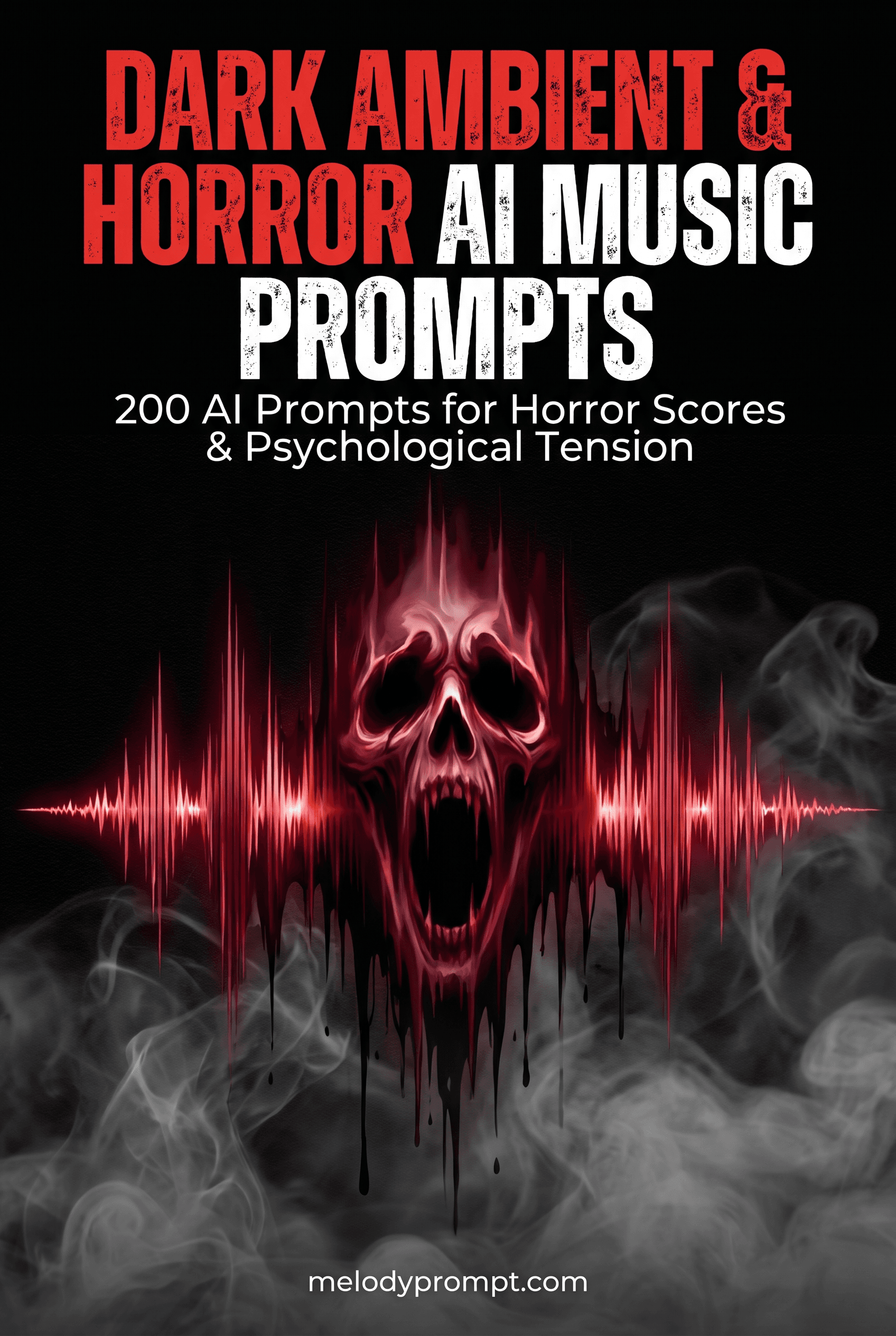
Volume 06 — Dark Ambient / Horror
Horror music works through the sustained violation of expectation — the note that shouldn't be there, the silence where a beat should land. This book gives you 200 dark ambient suno prompts for film soundscapes, game atmospheres, and psychological horror, each built to trigger the specific unease that makes a scene unbearable in the best way.
Why certain frequencies and rhythmic structures trigger fear, and how to encode these into Suno and Udio prompts.
40 prompts for quiet, sustained dread — the horror of what you can't see.
35 prompts for the sonic character of monsters: low-frequency rumble, biological distortion, irregular breathing.
30 prompts for the acoustic signature of abandoned hospitals, empty houses, underwater spaces.
35 prompts for interactive horror scoring — music that suggests imminent threat without resolving it.
25 prompts for extreme sonic discomfort: industrial clang, flesh-toned percussion, feedback drones.
How to build a horror soundtrack from ambient bed through tension to the full jump-scare sting.
35 additional prompts including folk horror, cosmic horror, demonic possession, and apocalyptic soundscapes.
Frequency ranges, common horror production techniques, and Suno/Udio-specific horror vocabulary.
Horror music operates on principles that are almost the opposite of most other genres. Where pop music rewards the listener with satisfying resolution, horror music specifically withholds it. Where ambient music creates comfort through predictable evolution, horror ambient creates discomfort through irregular events and violated expectations. Understanding this inversion is the key to writing dark ambient suno prompts that actually produce effective horror soundscapes.
Certain frequencies reliably trigger stress responses in human listeners. Sub-20Hz infrasound creates a sense of unease without an identifiable source — the physical sensation without the cognitive label. The tritone (augmented fourth interval) has been called "diabolus in musica" since medieval theory and remains one of the most reliable tension-generators in music. Irregular rhythms that don't resolve to a steady pulse keep the nervous system on alert. The horror music prompts in this book encode these psychoacoustic principles into each prompt, rather than simply describing a scary scene and hoping the AI infers the right sonic response.
Horror is not a monolithic genre. Psychological dread is the quiet wrongness of something that shouldn't be happening — it requires sustained, barely-moving atmospheres with occasional disturbing interruptions. Creature and monster scoring requires low-frequency biological textures and irregular rhythmic patterns that suggest something living but not human. Haunted spaces require the acoustic signature of emptiness plus traces of past human presence. Survival horror for video games requires music that can loop without being predictable — a specific compositional challenge that Chapter 5 addresses directly.
The most important element in effective horror scoring isn't a sound — it's the absence of one. The beat that doesn't land after you've established a pattern. The held note that suddenly cuts rather than resolving. These prompt elements are included explicitly in the dark ambient suno prompts throughout this book, using phrases like "silence as structural element" and "no resolution" that reliably trigger the desired compositional approach in Suno v4 and Udio.
The 35 survival horror game prompts in Chapter 5 are designed for a specific challenge: music that loops without becoming predictable. A game-score horror cue can play for 20 minutes while a player explores a level — it can't have an obvious loop point, and it needs to maintain tension across that entire duration. Chapter 7 covers how to chain these prompts into longer-form scored sequences for film and game applications using Suno's continuation features.
Chapter 6 covers the extreme end of horror sound design — industrial noise, body horror, and psychological torture soundscapes. These prompts are for advanced applications: extreme cinema, horror games targeting mature audiences, or art installations. The prompt engineering for ai music at this end of the spectrum requires very specific instrumentation vocabulary, which the appendix provides in full.
Sample — the full book has 200 like these.
[Genre: dark ambient / psychological horror] [Mood: dread, paranoia, something wrong you can't identify] [Instrumentation: low-frequency sine drone with slow LFO tremolo, reversed piano notes, irregular metallic tapping, no identifiable rhythm] [Vibe: realizing mid-conversation that something is watching] — extremely slow evolution, no resolution, sub-20Hz rumble layer, dark ambient suno prompts style
[Genre: horror ambient / hauntology] [Mood: grief-saturated wrongness, temporal displacement, institutional horror] [Instrumentation: decayed music box melody, long empty reverb, distant children's voices, slow pulse at 20 BPM, creaking structure sounds] [Vibe: a hospital that closed thirty years ago but the lights still come on at night] — monophonic, extremely sparse, horror music prompts quality
[Genre: survival horror game score] [Mood: imminent threat, hypervigilance, shallow breathing] [Instrumentation: string tremolo sul ponte, bass clarinet irregular phrases, sparse percussive thuds at unpredictable intervals, silence as structural element] [Vibe: player in a dark corridor, torch almost out, knows the monster is close] — no repetitive loop, every 8 bars different, game-score standard
You're making Dark Ambient / Horror tracks in your home studio. You know AI can speed up your workflow but you're tired of trial-and-error prompting. This book gives you 200 tested starting points — just paste and generate.
You need dark ambient background music for YouTube, TikTok, or Reels. The prompts in this book are formatted for instant use and produce output that clears the quality bar for professional content.
You're integrating AI into a professional composing workflow. The GMIV framework in this book gives you a systematic, repeatable approach to AI-assisted dark ambient / horror scoring that produces usable reference material quickly.
One studio-ready prompt — built on the GMIV framework, tested in Suno and Udio — runs about 5¢ when you buy a book at the launch price. The same prompt from a freelance producer averages $30–80. A 6-hour Suno prompt-engineering course on the major platforms sits at $199. A single hour of session time with a working composer is $120 minimum. You're not buying inspiration. You're buying 200 prompts that work the first time.
Competitor and consult prices are approximate, based on publicly listed Q1 2026 prices on Skillshare, Udemy, and Fiverr.
Volume 02
200 Massive AI Prompts for Trailer Music & Film Scores — Suno & Udio
More infoVolume 04
200 AI Prompts for Chill, Study, Sleep & Night Drives
More infoVolume 10
A Professional System for Studio-Ready AI Music
More info200 studio-ready dark ambient suno prompts · Instant PDF download