Volume 06
Dark Ambient & Horror AI Music Prompts
200 Soundscapes for Film, Game & Nightmare Atmospheres
More info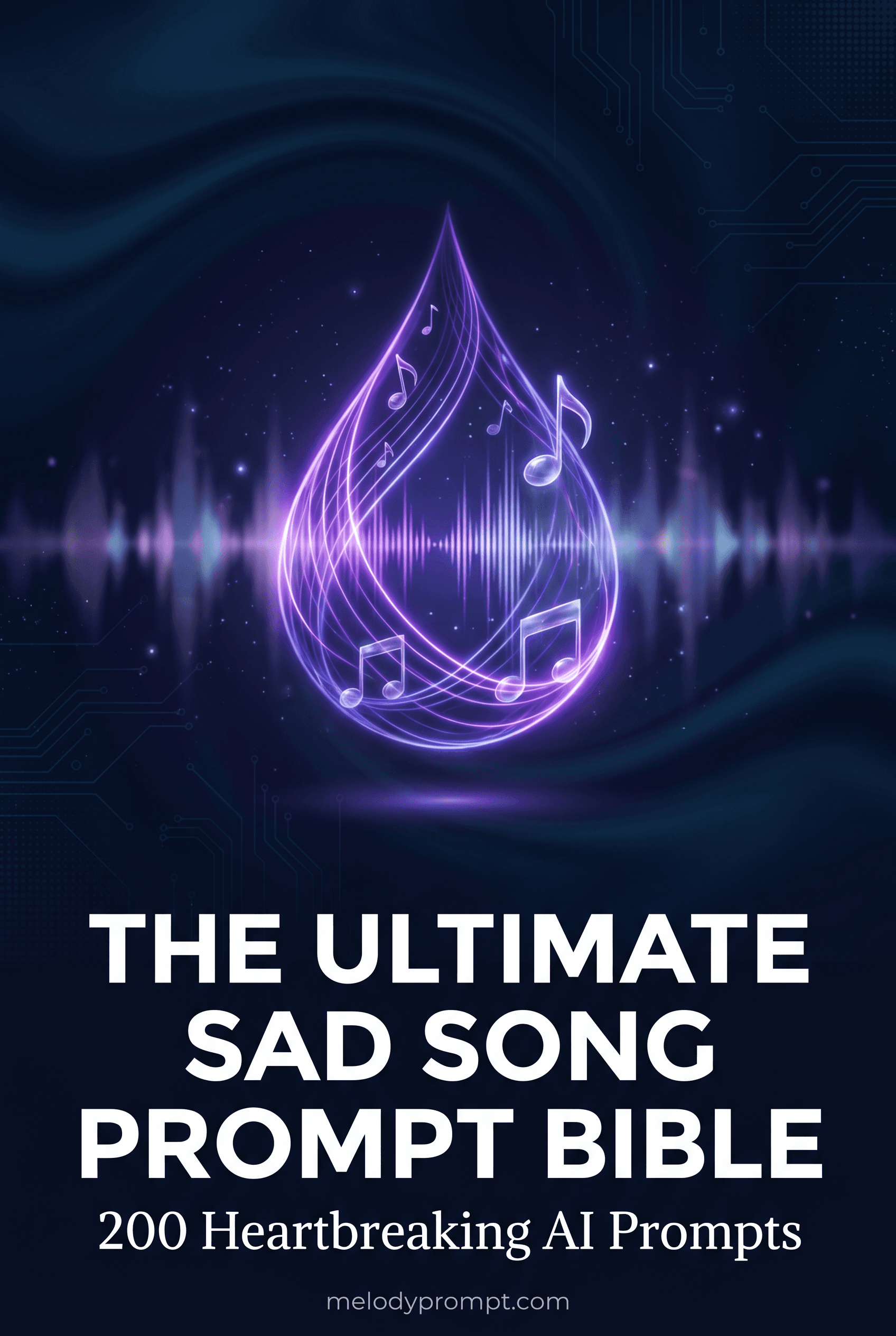
Volume 01 — Emotional / Sad
Most sad song prompts produce generic piano ballads that all sound the same. The Sad Song Prompt Bible gives you 200 precision-crafted prompts built on the GMIV framework — genre, mood, instrumentation, and vibe — so every track carries genuine emotional weight, tested live in Suno v4 and Udio.
Why vague emotion cues produce bland output, and how specificity unlocks Suno's latent grief vocabulary.
40 prompts for quiet devastation — piano, fingerpicked guitar, and orchestral swells.
30 prompts designed for film-score sadness: string quartets, tape hiss, late-night rain rooms.
30 prompts for soul-heavy sadness — midnight R&B, neo-soul, and urban lament.
30 prompts for indie-folk and bedroom-pop melancholy: lo-fi recording, raw vocals, honest loss.
30 prompts for electronic sadness — ambient drone, downtempo beats, glitch-touched loneliness.
How to chain prompts to build a complete emotionally-arced sad track from intro to outro.
40 additional field-tested prompts across every sub-genre, including winter themes, late-night drive, and loss of self.
The complete GMIV framework quick-reference and a checklist for crafting your own prompts.
Most people trying to generate sad music with AI get the same result: a mid-tempo piano ballad with vague reverb and no real emotional core. The problem isn't the AI — it's the prompt. "Sad piano ballad" is like handing a film director one sentence and expecting a full scene.
Suno and Udio are trained on enormous corpora of music. When you give either model a generic prompt, it regresses to the mean — the most common musical pattern that fits your words. For sadness, that's almost always a slow 4/4 piano track with reverb. It's technically correct, but emotionally flat. Real heartbreak sounds like a lot of things: the hollow tick of a kitchen clock at 3am, a guitar that's slightly out of tune, a vocal that trails off mid-phrase because the singer can't finish the line.
The prompts in this book are built on the GMIV system: Genre, Mood, Instrumentation, and Vibe. Each element serves a specific purpose. Genre anchors the AI to a reference pool of real recordings. Mood layers emotional specificity — not just "sad" but "numb and hollow" or "grief that's almost become comfortable." Instrumentation describes the sonic palette: what instruments, what mic treatment, what production era. Vibe is the cinematic anchor — a scene, a moment, a place. Together, the four elements give the model enough constraints to produce something specific rather than generic.
This book organizes suno sad song prompts into five emotional territories. Slow burn ballads for the kind of sadness that's quiet and long. Cinematic weepers for film-score grief — the kind you'd score a montage with. R&B grief for soul-drenched, urban late-night heartbreak. Indie ache for the stripped-down, honest loss of bedroom pop and folk. Electronic emptiness for dissociation and ambient loneliness. Each chapter gives you 30–40 GMIV-formatted prompts, tested and refined across multiple Suno generations.
The suno ai prompt examples for emotional ballad in Chapter 3 are particularly useful for film and sync work — they're written to evoke specific visual scenarios, not just musical moods.
Every prompt was tested against Suno v4 and Udio in the four months before publication. When a prompt underperformed on one platform, it was revised until it hit a consistent output standard on both. You're not getting a list of things someone typed once and uploaded — these are field-tested, production-ready prompts that work the first time.
Producing an emotional AI track is only half the process. Chapter 7 covers how to chain prompts — using one output as inspiration for the next iteration — and how to use Suno's inpainting and extension tools to build a complete, emotionally-arced sad song from the prompts in this book. If you're releasing on Spotify via DistroKid or TuneCore, the appendix includes notes on AI music disclosure requirements as of Q1 2026.
The ai music prompt library in this volume is the most comprehensive collection of sad-music prompts available for Suno and Udio. At roughly 5¢ per studio-ready prompt, it's the lowest cost-per-result in the market.
Sample — the full book has 200 like these.
[Genre: slow-burn ballad] [Mood: devastated, numb, quietly hopeful] [Instrumentation: solo upright piano, cello pizzicato, distant room reverb, subtle vinyl crackle] [Vibe: 3am kitchen table, letter you never sent] — female vocals, breathy, conversational, verse-chorus-verse, 90 BPM
[Genre: indie folk] [Mood: wistful, tender grief, acceptance] [Instrumentation: fingerpicked acoustic guitar in DADGAD, harmonium drone, sparse brushed snare, close mic'd room sound] [Vibe: last summer before everything changed] — male vocal, slightly raw, unhurried, 75 BPM
[Genre: ambient electronic] [Mood: hollow, dissociated, searching] [Instrumentation: detuned synth pads, 808 sub rumble at 60 BPM, reversed piano chords, tape-echo on lead synth, no drums] [Vibe: driving home from a hospital at 5am] — instrumental, evolving 4-minute arc
You're making Emotional / Sad tracks in your home studio. You know AI can speed up your workflow but you're tired of trial-and-error prompting. This book gives you 200 tested starting points — just paste and generate.
You need emotional background music for YouTube, TikTok, or Reels. The prompts in this book are formatted for instant use and produce output that clears the quality bar for professional content.
You're integrating AI into a professional composing workflow. The GMIV framework in this book gives you a systematic, repeatable approach to AI-assisted emotional / sad scoring that produces usable reference material quickly.
One studio-ready prompt — built on the GMIV framework, tested in Suno and Udio — runs about 5¢ when you buy a book at the launch price. The same prompt from a freelance producer averages $30–80. A 6-hour Suno prompt-engineering course on the major platforms sits at $199. A single hour of session time with a working composer is $120 minimum. You're not buying inspiration. You're buying 200 prompts that work the first time.
Competitor and consult prices are approximate, based on publicly listed Q1 2026 prices on Skillshare, Udemy, and Fiverr.
Volume 06
200 Soundscapes for Film, Game & Nightmare Atmospheres
More infoVolume 02
200 Massive AI Prompts for Trailer Music & Film Scores — Suno & Udio
More infoVolume 10
A Professional System for Studio-Ready AI Music
More info200 studio-ready sad song prompts · Instant PDF download