Volume 01
The Ultimate Sad Song Prompt Bible
200 Heartbreaking AI Prompts for Suno & Udio
More info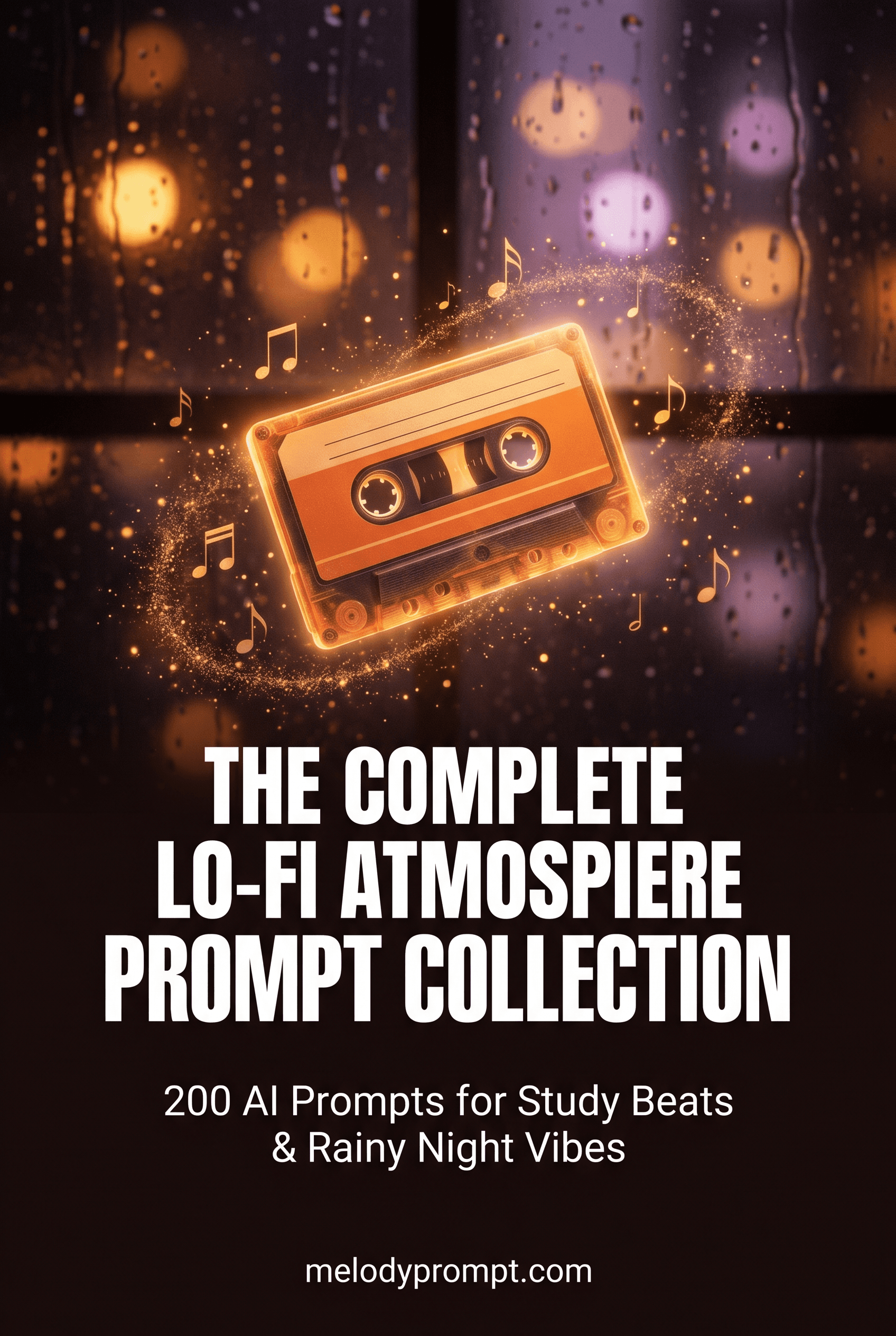
Volume 04 — Lo-Fi / Chill
Lo-fi is the most-streamed ambient genre on Spotify and YouTube, but the prompts most people use produce the same looping jazz chord with rain sounds. This book gives you 200 lo-fi suno prompts across study, sleep, late-night drive, and seasonal sub-genres — each built with the production specificity that separates lo-fi that streams from lo-fi that loops once and stops.
What makes lo-fi feel warm and humanized — and which prompt elements trigger these qualities in Suno and Udio.
40 prompts designed for focus and sustained listening — the lo-fi hip-hop that plays for 8 hours without fatigue.
35 prompts for deep relaxation: slow tempos, filtered frequencies, nature sound integration.
30 prompts for the city-at-3am aesthetic — jazz-influenced melodies over muted drum patterns.
30 prompts by season: winter lo-fi with snow ambience, autumn lo-fi with leaf-rain, spring lo-fi with birdsong.
30 prompts blending lo-fi textures with jazz harmony and neo-soul chord voicings.
How to build a 10-track lo-fi playlist using these prompts, including BPM sequencing and tonal variety.
35 additional prompts including lo-fi R&B, Japanese city-pop lo-fi, and lo-fi ambient drone.
Production terminology used in the prompts, with explanations for non-engineers.
Lo-fi is the most commercially successful ambient genre in the streaming era. Tracks with titles like "lo-fi hip-hop beats to study/relax to" regularly accumulate hundreds of millions of streams on YouTube and Spotify. But generating lo-fi music with AI that's actually worth listening to for longer than three minutes requires knowing exactly which production signals trigger the warmth, humanization, and gentle fatigue that the genre depends on.
The lo-fi sound is built on deliberate imperfection: vinyl surface noise, tape wow-and-flutter, compressed dynamics that feel like a bedroom recording rather than a studio. When you prompt Suno or Udio with just "lo-fi hip-hop," you get a statistically average version of the genre — usually a piano chord loop over a drum pattern, with generic vinyl crackle applied as an afterthought. The 200 lo-fi suno prompts in this book are built on a different approach: specifying the analog artifacts, the room sound, the instrument microphone placement, and the visual scene that anchors the vibe.
The three main use cases for lo-fi music require different prompt strategies. Study-mode lo-fi needs a slightly faster BPM (70–85), a more rhythmically active drum pattern, and melodic content that's engaging enough to set a focus mood without being distracting enough to pull attention. Sleep lo-fi needs a slower tempo (50–65 BPM), fewer drum elements, and longer note durations that don't jar the listener awake. Late-night drive lo-fi — the jazz-influenced city-at-midnight aesthetic — needs more harmonic complexity and a specific cinematic quality that the other categories don't.
Chapter 6 covers the lo-fi jazz crossover territory — the udio ai prompts style that blends jazz harmony, neo-soul chord voicings, and lo-fi production texture. This is the most musically sophisticated category in the book, and the one most likely to surface in editorial playlists that curate actual musical quality rather than just background-music utility.
One underutilized strategy for building a lo-fi catalog is seasonal releases. Winter lo-fi with snow ambience and warm piano performs particularly well on Spotify during the Q4 holiday period. The 30 prompts in Chapter 5 are organized by season, with specific ambient layer instructions (rain, wind, birdsong, coffee shop background) that trigger different environmental feelings in the listener.
Prompt engineering for ai music in the lo-fi space has developed a specific vocabulary that Suno and Udio both respond to reliably: "vinyl crackle," "tape saturation," "wow-and-flutter," "brushed kit," "room verb," "muted trumpet." The appendix in this book provides a complete glossary of these terms and what they trigger in each model, so you can mix and match elements to create your own lo-fi prompts beyond the 200 in the catalog.
Sample — the full book has 200 like these.
[Genre: lo-fi hip-hop] [Mood: focused, warm, gentle productivity] [Instrumentation: upright bass pluck, jazz piano chords with tape saturation, brushed drum kit at 75 BPM, vinyl crackle, slight wow-and-flutter on piano] [Vibe: library carrel, 2pm sunlight through dusty windows] — instrumental, no synth, 4-minute loop potential, lo-fi suno prompts standard
[Genre: lo-fi jazz / chillhop] [Mood: introspective, gentle melancholy, city solitude] [Instrumentation: muted trumpet melody, walking bass, brushed hi-hat, Rhodes pad with flutter, distant city ambient layer] [Vibe: 24-hour diner, streetlights reflecting on wet pavement] — 65 BPM, no kick drum, jazz harmony, udio ai prompts quality
[Genre: lo-fi ambient] [Mood: deeply calm, floating, dissociative comfort] [Instrumentation: sine wave pads with slow LFO, gentle rain recording underneath, acoustic guitar harmonics, no drums, sub-bass drone] [Vibe: falling asleep watching rain on the window] — 50 BPM, mostly static dynamics, sleep/ASMR quality, pure atmosphere
You're making Lo-Fi / Chill tracks in your home studio. You know AI can speed up your workflow but you're tired of trial-and-error prompting. This book gives you 200 tested starting points — just paste and generate.
You need lo-fi background music for YouTube, TikTok, or Reels. The prompts in this book are formatted for instant use and produce output that clears the quality bar for professional content.
You're integrating AI into a professional composing workflow. The GMIV framework in this book gives you a systematic, repeatable approach to AI-assisted lo-fi / chill scoring that produces usable reference material quickly.
One studio-ready prompt — built on the GMIV framework, tested in Suno and Udio — runs about 5¢ when you buy a book at the launch price. The same prompt from a freelance producer averages $30–80. A 6-hour Suno prompt-engineering course on the major platforms sits at $199. A single hour of session time with a working composer is $120 minimum. You're not buying inspiration. You're buying 200 prompts that work the first time.
Competitor and consult prices are approximate, based on publicly listed Q1 2026 prices on Skillshare, Udemy, and Fiverr.
Volume 01
200 Heartbreaking AI Prompts for Suno & Udio
More infoVolume 09
200 AI Prompts for Honest Songs from the Front Porch
More infoVolume 10
A Professional System for Studio-Ready AI Music
More info200 studio-ready lo-fi suno prompts · Instant PDF download