Volume 03
The Hip-Hop Prompt Architect
200 Studio-Ready AI Prompts for Trap, Boom-Bap, Drill & R&B
More info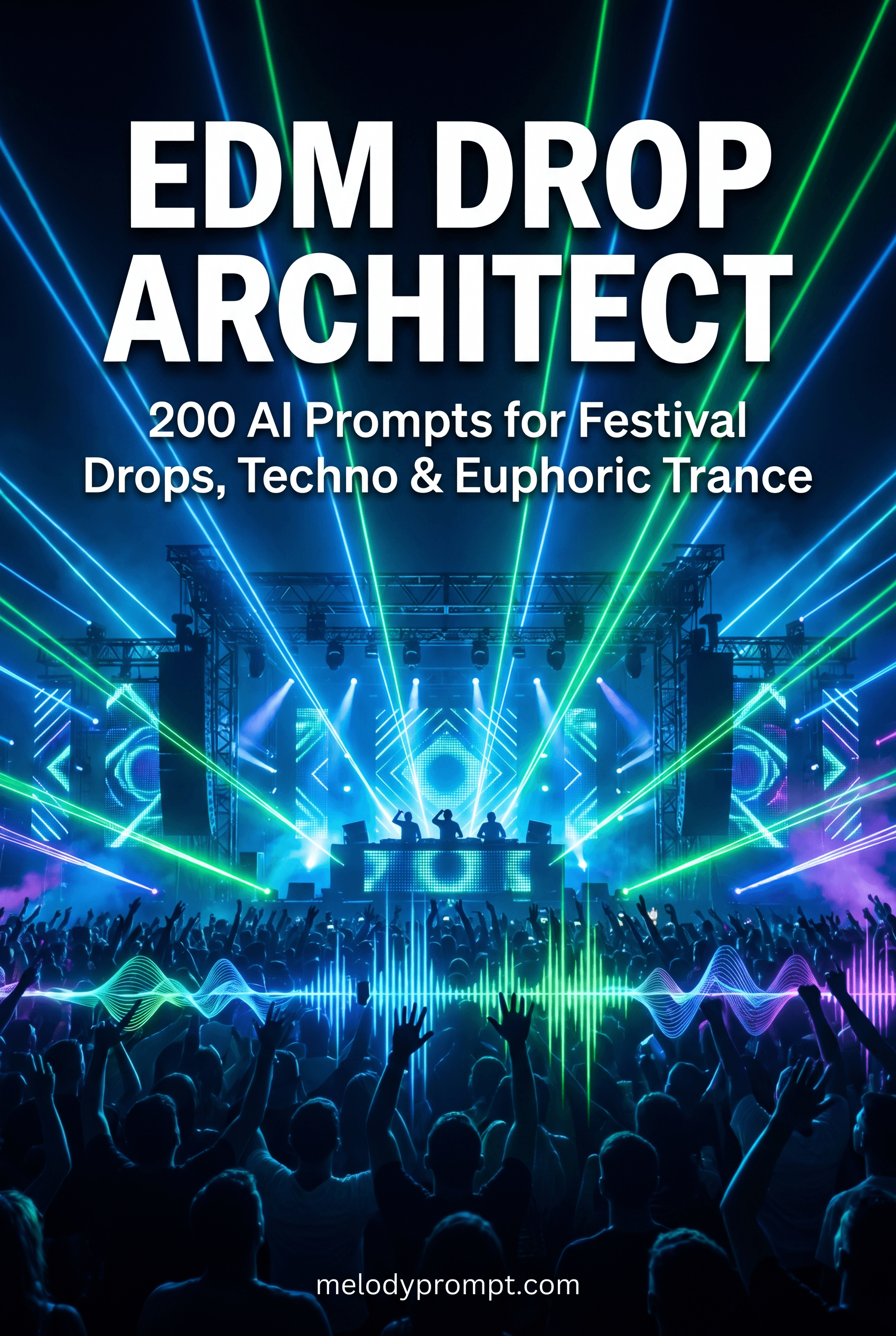
Volume 07 — EDM / Electronic
The drop is everything in EDM — the moment the crowd's arms go up, the bassline slams in, and four weeks of tension resolution happens in a single bar. These 200 EDM suno prompts are engineered specifically for that moment: the build, the breakdown, and the drop, across big room, future bass, tech house, and dubstep.
How the build-breakdown-drop-outro structure works and how to encode each phase into a dedicated Suno prompt.
40 prompts for stadium-sized house music: wide leads, massive kicks, crowd-ready drops.
35 prompts for the SuperSaw-heavy, emotionally charged future bass sound of post-Flume EDM.
30 prompts for the club-focused, groove-driven tech house aesthetic.
35 prompts for bass-heavy dubstep, riddim, and heavy electronic music.
30 prompts for the emotional, evolving structure of melodic techno and progressive house.
How to chain the prompts in this book to construct a complete festival-ready EDM track.
30 additional prompts including trance, drum and bass, hardstyle, and ambient house.
Glossary of EDM production terms used in the prompts, with Suno and Udio equivalents.
In EDM, everything is structured around one moment: the drop. The build creates tension through rising filters, noise sweeps, and escalating synth stacks. The breakdown strips the music down to near-silence, creating maximum tension before the release. The drop delivers the payoff — kick drum, bassline, and lead all slamming in simultaneously at peak intensity. Getting this arc right in an AI-generated track requires encoding the emotional function of each section, not just its sonic characteristics.
The most common failure mode for EDM suno prompts is prompting for a sound rather than an arc. "Big room house" as a prompt produces a technically correct but emotionally inert result — correct instrumentation but no sense of tension and release. The 200 prompts in this book encode the emotional function at each structural moment: the anticipation of a build, the restraint of a breakdown, the euphoria of a drop. This functional encoding is what separates festival-ready AI music from generic dance music output.
The book covers five EDM territories that each require distinct prompt approaches. Big room house is the stadium-ready, maximum-energy format with wide leads and four-on-the-floor kicks. Future bass — the sound of Flume, Marshmello, and their successors — is about emotional weight through detuned SuperSaw chords and melodic bass movement. Tech house is groove-driven and hypnotic rather than euphoric. Dubstep is bass-first, with the wobble as the primary melodic element. Melodic techno and progressive house are the most compositionally sophisticated, requiring slow evolution over 7–8 minutes.
Chapter 7 covers the practical workflow: using three separate prompts (one for the build section, one for the breakdown, one for the drop) and chaining them using Suno's Continue feature. This is the most reliable way to get a full, structurally correct EDM track from AI. Single-prompt EDM tracks tend to plateau emotionally because the model has to compress all three phases into one generation.
Udio's synthesis modeling produces some of the most musically sophisticated electronic music of any AI model. The best udio prompts for tech house and minimal techno produce output that sounds genuinely different from Suno's approach to the same prompt — more rhythmically sophisticated, with a more accurate representation of club-music groove. Chapter 4's tech house section includes specific Udio-optimized prompts noted inline.
Studio-ready ai music prompts for EDM are written to minimize post-production time. Every prompt is tested against the question: can a producer take this output, apply basic mixing and mastering, and have something genuinely playable? The EDM market has increasingly embraced AI as part of the production workflow, and these prompts are designed to fit that workflow cleanly.
Sample — the full book has 200 like these.
[Genre: big room house / EDM] [Mood: euphoric release, hands in the air, peak festival energy] [Instrumentation: four-on-the-floor kick at 128 BPM, white-noise riser before drop, super-saw lead chord stab, sidechain compression hard on bass, clap on 2+4, pluck arp in breakdown] [Vibe: main stage, Saturday night, 60,000 people all facing forward] — drop hits at bar 33, no vocals, massive reverb on lead, EDM suno prompts style
[Genre: future bass / melodic bass] [Mood: euphoric-melancholic, emotionally overwhelming, beautiful sadness] [Instrumentation: Super Saw chord stacks detuned ±20 cents, chopped vocal sample in buildup, punchy kick with heavy sidechain, bass wobble on drop, lush reverb wash in breakdown] [Vibe: last song before sunrise, everyone knows it's almost over] — 150 BPM, F# minor, best udio prompts quality
[Genre: tech house / minimal techno] [Mood: hypnotic, physical, underground club in basement] [Instrumentation: driving kick at 130 BPM, sub bass groove with swing, hi-hat with triplet ghost notes, percussion loop with organic texture, filter sweep rising over 4 bars] [Vibe: 3am, concrete walls, 200 people all moving the same way] — minimal melody, drum-forward, groove never drops out, udio prompts style
You're making EDM / Electronic tracks in your home studio. You know AI can speed up your workflow but you're tired of trial-and-error prompting. This book gives you 200 tested starting points — just paste and generate.
You need edm background music for YouTube, TikTok, or Reels. The prompts in this book are formatted for instant use and produce output that clears the quality bar for professional content.
You're integrating AI into a professional composing workflow. The GMIV framework in this book gives you a systematic, repeatable approach to AI-assisted edm / electronic scoring that produces usable reference material quickly.
One studio-ready prompt — built on the GMIV framework, tested in Suno and Udio — runs about 5¢ when you buy a book at the launch price. The same prompt from a freelance producer averages $30–80. A 6-hour Suno prompt-engineering course on the major platforms sits at $199. A single hour of session time with a working composer is $120 minimum. You're not buying inspiration. You're buying 200 prompts that work the first time.
Competitor and consult prices are approximate, based on publicly listed Q1 2026 prices on Skillshare, Udemy, and Fiverr.
Volume 03
200 Studio-Ready AI Prompts for Trap, Boom-Bap, Drill & R&B
More infoVolume 05
200 AI Prompts for Viral Commercial Music — Suno & Udio
More infoVolume 10
A Professional System for Studio-Ready AI Music
More info200 studio-ready EDM suno prompts · Instant PDF download